What Spatial Costs You
The four recurring costs a spatial archetype signs up for, why cluster tightness governs the query bill, and how to choose a cell size.
Status: ✅ Implemented · Visibility: Public · Level: 🟢 Start Here · Category: Spatial
Assumes: Entity Clusters
🎯 What it solves
Declaring a spatial field costs one attribute. What it buys is a per-cell broadphase that answers "what is near this box" without touching most of the world. What it costs is work the engine does every tick whether you query or not: keeping each cluster's bounding box current, moving entities whose position left their cell, and re-packing clusters whose bounds have spread until they no longer prune anything.
That recurring bill is the subject of this page. It exists because the rest of the category teaches the surface and then stops — and a reader who stops there meets the cost later, as an unexplained rise in tick time, with no vocabulary for what moved. Read this before you read any API page. It names the four cost centres, states which of them scale with what, and gives the one sizing decision that governs all four.
Nothing here is an API surface. [SpatialIndex] and its arguments live on
Field Attribute & Schema Integration, the parameters live on
Tuning the Spatial Grid, and the counters that tell you which cost centre is hurting live
on Reading Spatial Telemetry.
⚙️ How it works (in brief)
Three words carry the whole model, and they nest.
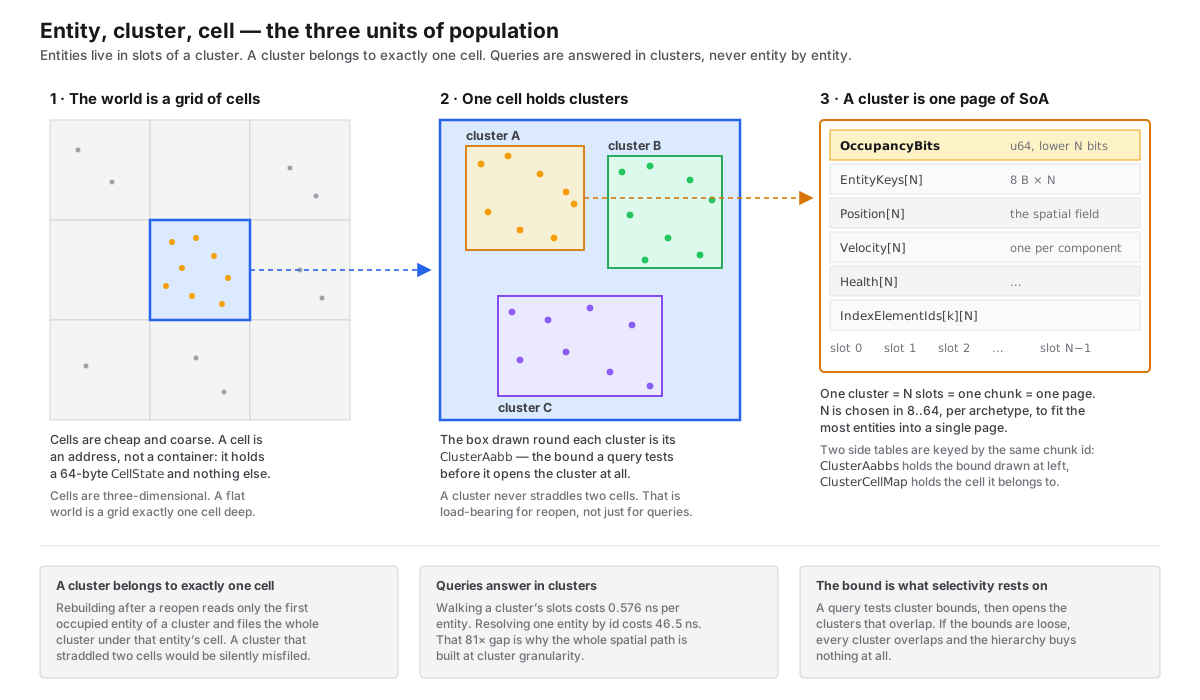
An entity has a position. A cluster is up to 64 entities of one archetype in one contiguous chunk, carrying a single bounding box. A cell is a fixed-size box of world space holding the clusters whose entities live in it. Every cost on this page is paid per cluster or per cell, never per entity — except repair, which is the one that is paid per entity.
A cluster belongs to exactly one cell, and that is an invariant rather than a tendency: cell membership is decided by an entity's centre, and an entity whose centre leaves the cell is moved to a cluster of the new cell. Because of that, every cell-scoped operation — tier assignment, dormancy, broadphase — tests one bounding box per cluster instead of one position per entity.
One structure, and you do not choose it
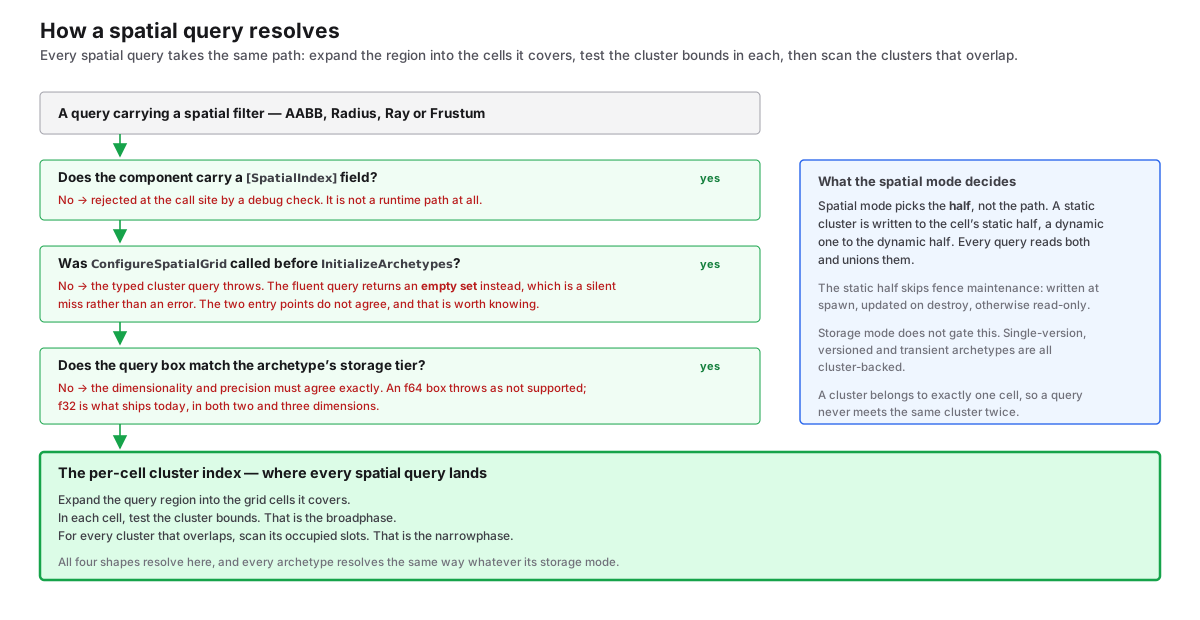
Every spatial query resolves through the per-cell cluster broadphase. There is no second index and no fallback path.
Three facts follow from that, and they matter more than any number on this page:
- There is exactly one spatial index, and it is the per-cell cluster index. Every query shape — box, radius,
ray, frustum, k-nearest — resolves through the cell broadphase. A component carrying
[SpatialIndex]allocates no spatial storage segment of its own. A reflection test walks the whole engine assembly to hold that true. - Storage mode does not select a path. Every archetype is cluster-backed, whatever its components' storage modes, so storage mode decides only where component data sits inside the cluster, not which structure answers a query.
- The grid is therefore mandatory, not optional. An archetype that declares a spatial field and finds no
configured grid throws
InvalidOperationExceptionatInitializeArchetypes, naming the archetype. It fails at startup deliberately, rather than at the first spawn.
The consequence for cost is simple. You cannot opt a spatial archetype out of the cell machinery, so the four costs below are not optional either. What you control is their magnitude.
The four cost centres
1. Query broadphase — paid per query
A query expands its box into the cells it overlaps, and in each cell scans a linear array of cluster bounding boxes. Every cluster whose box overlaps is opened: its live entities are then tested individually. So the price of a query is the number of clusters it opens, and opening a cluster is cheap only because iterating one is — 0.576 ns per entity, against 46.5 ns to resolve one entity by id, a factor of 81.
The broadphase is a linear scan. A cell half can be promoted to a tree once it holds
DatabaseEngineOptions.Spatial.CellTreePromoteThreshold clusters — int.MaxValue, never, by default since September
2026 (see the note below the table). The case for a tree, on ideal tiling:
Query cost, tree against linear scan, by how selective the query is (sel is the query edge as a fraction of the
cell edge). Above 1.00× the tree wins:
| Clusters in one cell | sel 0.02 | sel 0.10 | sel 0.30 | sel 1.00 |
|---|---|---|---|---|
| 80 | 0.18× | 0.18× | 0.12× | 0.07× |
| 512 | — | 0.70× | 0.35× | 0.09× |
| 1 563 | 4.24× | 2.03× | 0.64× | 0.08× |
| 6 250 | 13.2× | 3.80× | 0.86× | 0.07× |
| 15 625 | 18.7× | 4.50× | 1.00× | 0.07× |
These ratios predate the September 2026 vectorisation of both structures and are kept as the calibration the default threshold was chosen from. Vectorising the linear scan gained it 67–70 % on a selective query against the tree's 12–14 %, so every ratio in this table now understates the scan. Re-measured at the two points that matter: 512 clusters selective, 102 ns scanned against 247 ns through the tree; 2 048 selective, 403 ns against 246 ns. The tree's advantage at extreme density is real but arrives later than these rows suggest.
Off by default since 2026-09-10 (#917). On a game-shaped workload — #906's SWG Tatooine at 16× population, cells of 1 024 to 16 384 m — a forced tree made the tick 1.43–1.75× slower at every density: its refit runs in the fence's serial tail, and at 4 000+ clusters its 3–4× broadphase win is ~1.1× on the whole query, which the narrowphase dominates.
Two things fall out of that. The tree loses every column at 512 and first wins at 1 563, which is where the old 1024 default sat — on the conservative side of the boundary. And the tree never wins a broad query at any density: a query that returns most of the cell has nothing to prune, so it pays the descent for nothing. Promotion helps selective queries against dense cells, which is the case it exists for.
The update side moves the other way — a tree update is 20.8× dearer than six float stores at 512 clusters and 29.9× at 1 563. The motion hysteresis is what makes that affordable: at the shipped margin it absorbs ~97 % of moves, bringing the real cost to 61 ns against 23 ns per moved cluster. A cell that is dense and rewrites every cluster every tick while querying rarely is the one case where raising the threshold is the right call.
A real clumped population in the same sweep held 1.8 clusters per cell on average, 102 in its worst cell — an order of magnitude below where promotion begins, which is why most databases never build a tree.
2. Tick-fence maintenance — paid per tick, per written cluster
At the tick fence the engine recomputes the bounding box of every cluster that was written to, and clusters nobody touched are skipped entirely. Positions written through the spatial write barrier are cheaper still: the barrier grows the cluster box in place as it writes, flags the exact slot that crossed a cell boundary, and marks the one cluster the fence must revisit — so the fence drains the work without searching for it.
Where the barrier is not used, the fence has to find the crossings itself, in its Prep phase. That phase is already the largest of the fence: 52% of fence time at eight workers, rising to 64% at 128 000 entities, and it scales worst of the three phases (1.28× against 3.54× for migration and 4.45× for box refresh). Prep is the part of the fence that does not get cheaper when you add cores.
3. Inter-cell migration — paid per entity that leaves its cell
An entity whose centre leaves its cell by more than a hysteresis margin is queued during Prep and moved during the fence's Migrate phase: component data, secondary index entries and the spatial back-pointer move together. Migration is systematic and never refused — it is what makes the cluster-cell invariant hold, so the engine will always pay it.
Its rate is set by your world, not by a parameter: entity speed divided by cell size. Halving the cell size doubles the boundary crossings. The hysteresis margin removes only the oscillation of entities loitering on a boundary, not genuine traffic.
4. Intra-cell repair — paid per entity, and the dearest thing here
Nothing above fixes a cluster whose entities have drifted apart inside their cell. That is what relocation and repair are for, and repair is the one cost on this page that is measured per entity and is large:
Order of magnitude: roughly a microsecond per entity, which puts a single 100 000-entity cell re-sorted in one
pass at ~130 ms. That is enough to miss a frame on its own, and it is why ReclusterBudgetMs exists and why the
budget — not the queue — decides how much repair a tick actually gets.
| Quantity | Measured |
|---|---|
| Tick fence per repaired entity, warm | ~1 300 ns (1 058 – 1 619 across ten warm rounds) |
| First repair in a process | 22 000 – 29 700 ns — JIT and first page touches, not signal |
| One 100 000-entity cell, projected | ~130 ms |
Read that first row for what it is. It divides a whole WriteTickFence by the number of entities the repair
moved, so it also carries the AABB refresh, the WAL emit and the harness's own page writeback. It is the right
number for sizing a budget and the wrong number for costing the re-sort itself, which is nearer half of it.
Do not tune against this table. The engine measures your workload on your hardware and exposes it as
MeasuredNsPerEntity; RepairNsPerEntity only seeds that estimate for the first few ticks. What one pass buys is real: mean cluster extent fell from 87.0 to 23.0 against a theoretical
optimum of 15.6, and the cell's zone maps narrowed to 22% of their previous total width.
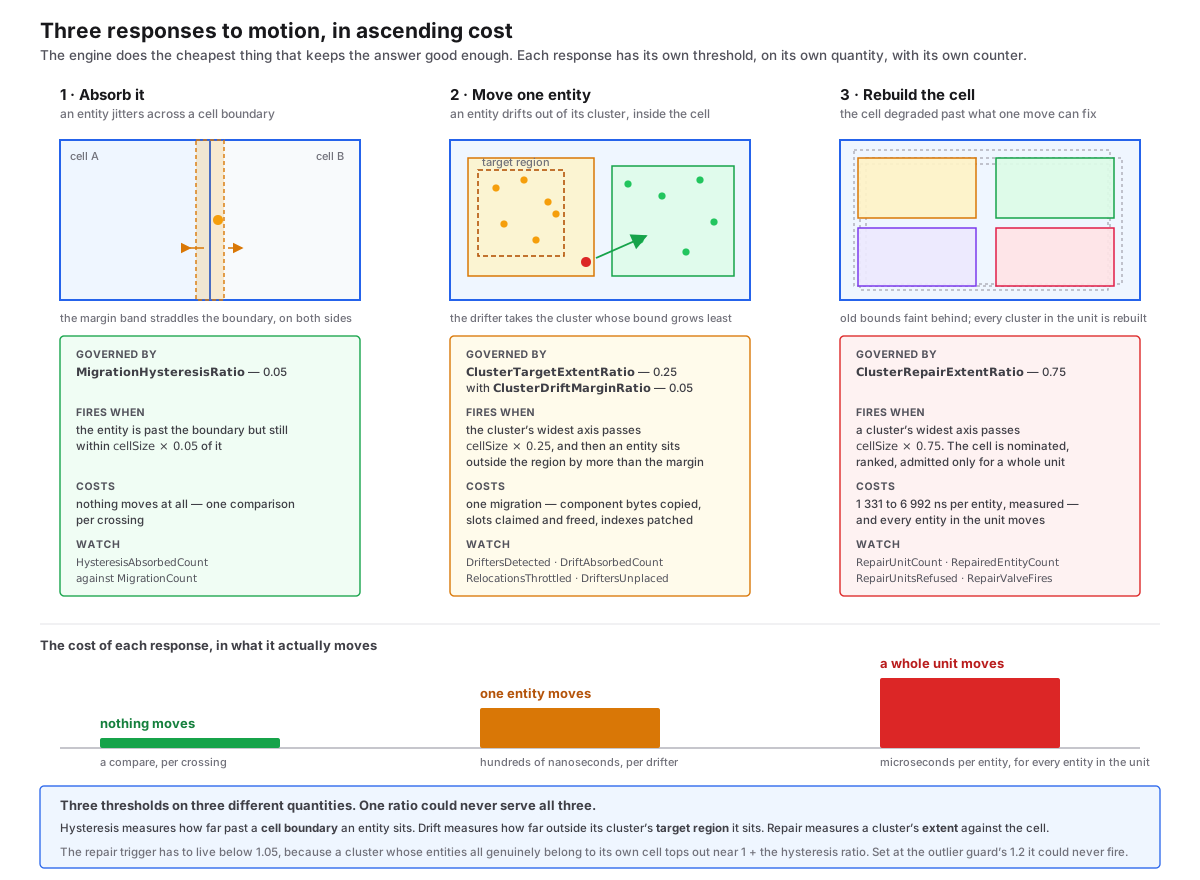
The three responses to a cell losing tightness, in ascending cost. Hysteresis absorbs a jitter for free. Relocation moves the individual entities that overshot a box around their cluster's centroid. Repair re-sorts a whole cell in Morton order and is the only mechanism that ever narrows a zone map.
Repair is budgeted per tick per archetype and, crucially, relocations that do not fit the budget are dropped, not deferred. Nothing remembers them; the next tick re-detects whatever still drifts. Repairs, by contrast, are remembered in a per-cell queue ranked by degradation and age. A recent measurement of the detection stage found 55 415 relocations nominated against 1 288 admitted, a ratio of 43 to 1 — detection is currently the largest single term in two fence phases, and most of what it produces is discarded.
Why tightness governs the bill
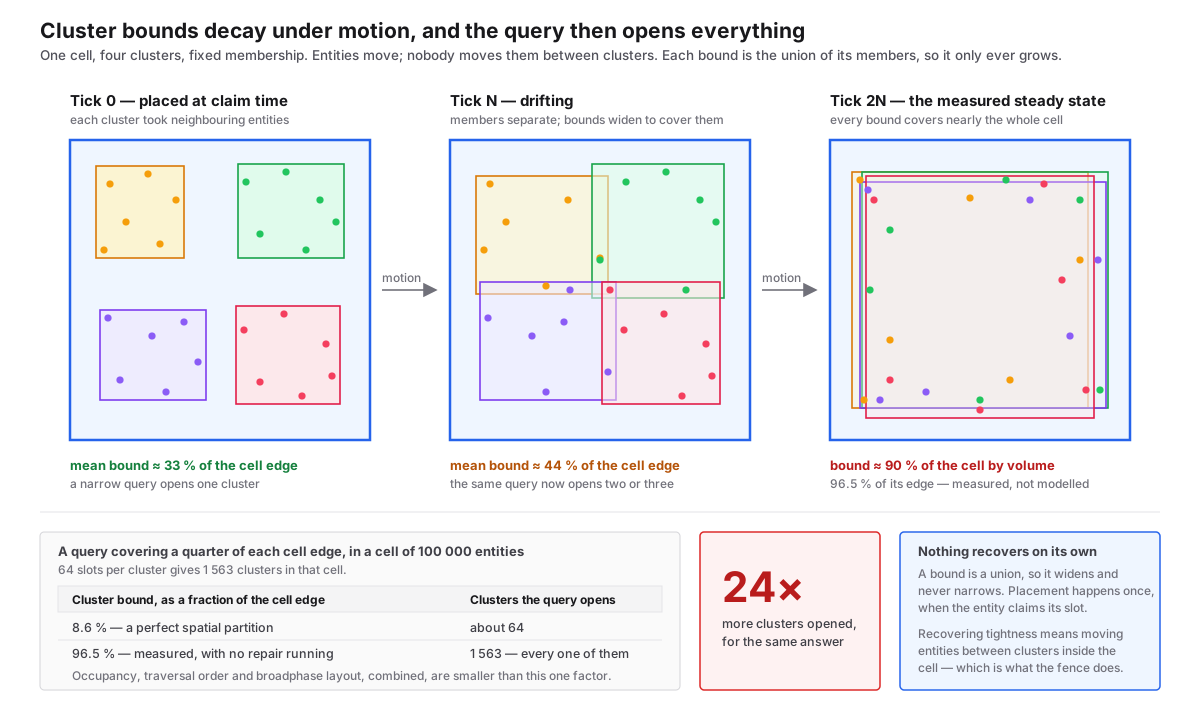
Placement happens once. Under motion a cluster's box only widens, until it covers most of its cell and stops excluding anything.
An entity is placed at claim time, into the first cluster of its cell with a free slot. That choice is not position-aware, and it is never revisited by the placement path. A cluster's bounding box therefore only ever grows as its entities move — there is no force pulling it back in, which is precisely why relocation and repair have to exist as separate mechanisms.
The effect on query cost is severe, and it is arithmetic rather than a subtlety. Take one cell holding 100 000 entities. At 64 slots per cluster that is about 1 563 clusters:
- Under a perfect partition, each cluster's box spans about 8.6% of the cell edge. A query box covering a quarter of that edge overlaps roughly 64 clusters.
- At the decayed extent, 96.5% of the cell edge, the same query overlaps all 1 563 of them.
That is a 24× swing in clusters opened, for one identical query, decided entirely by how tight the clusters are. The 90% mean coverage that motivates the figure is measured; the 24× itself is derived from it and has never been measured end to end. Treat it as the shape of the problem rather than as a benchmark result.
Choosing a cell size
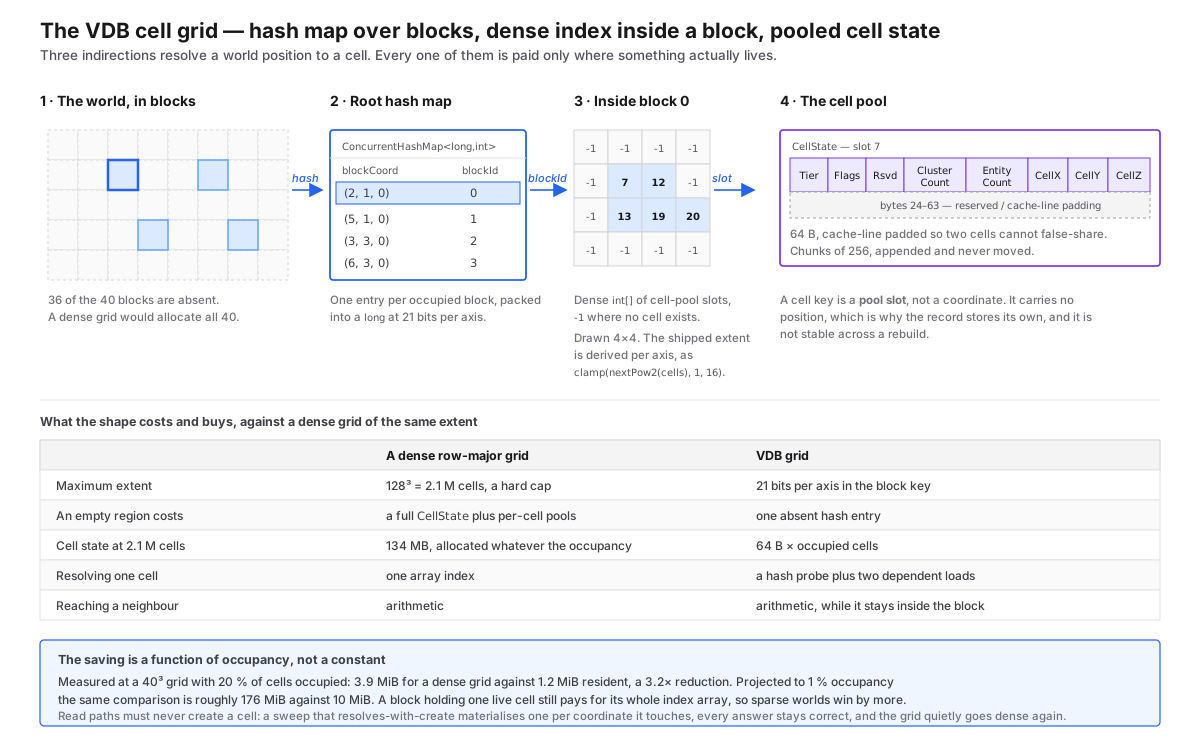
The grid is sparse and three-level: a hashed root of blocks, a dense index inside each block, and a pool holding only cells that are actually occupied. Empty space costs nothing to leave empty.
Cell size is the one number that moves all four cost centres at once, and it is the only one you must choose from first principles rather than by watching a counter. Everything else in the category has a defensible default.
Size it by occupancy — the number of entities you expect in an average populated cell — and not by any distance in your world:
| Entities per cell | Consequence |
|---|---|
| 4 | cells outnumber clusters; boundary crossings, and therefore migrations, are at their most frequent |
| 16 – 64 | around one cluster per cell, up to one full cluster — where the small synthetic sweep bottomed out, not a target |
| 256 | clusters per cell rise; the broadphase opens more of them per query, and prunes between them |
| 1 024 and above | a repair unit becomes an expensive, indivisible piece of work. Query selectivity depends on cluster extent against the query radius rather than on this count, and a game-shaped workload measured its optimum here |
The harness that produced this sweeps occupancy at 4, 16, 64, 256, 1 024 and 4 096 entities per cell, so its curve is resolved to those grid points and no finer — and occupancy is the harness's axis, not a knob you set. Several clusters per cell is the normal, intended shape (a cluster holds 64 slots, and the cell-level broadphase exists precisely to prune between clusters); a game-shaped workload measured its optimum with dozens of clusters per cell. The real upper bound is the repair unit: beyond a few thousand entities in a cell you are building the ~130 ms indivisible piece of work measured above.
Sparsity is not a reason to hesitate over small cells. Only occupied cells are allocated: a 40³ world at 20% occupancy resides in 1.2 MiB against 3.9 MiB dense, a factor of 3.2. The ratio tracks occupancy — it is not a constant, and a denser world saves less.
💻 Usage
There is no call on this page. The sizing decision is arithmetic you do once, before configuring the grid on Spatial Grid Configuration & Tier Control:
cell side = dominant query radius / ClusterTargetExtentRatio (0.25 by default, so ~4x the radius)
A cell holds clusters, not entities, and its size is what caps how wide a cluster may grow
(max(density-derived target, ClusterTargetExtentRatio) × GrowthCapSlack × CellSize). So the sizing question is what
extent you want the cluster gate to prune at, which is the scale your queries test — not an entity count, which is a
consequence of your population rather than a knob.
Worked, for a workload whose dominant query is a 50-unit radius: a cell side of about 200 units puts the cluster extent cap near 50. Treat it as a starting point and confirm it by sweeping, not by arithmetic — the two workloads measured so far put the optimum an order of magnitude apart, and Spatial Tuning carries both tables.
Two sanity checks before you accept a number. Your largest entity extent should be small against the cell side, because every query walks the cells its region can reach — its own extent grown by the archetype's cluster reach — so entities large against the cell widen every query's walk (see the limits below). And your entity speed per tick should be small against the cell side, or every entity migrates most ticks.
⚠️ Guarantees & limits
- Repair costs roughly a microsecond per entity — about 1 300 ns of tick fence per repaired entity warm, projecting a 100 000-entity cell at ~130 ms for one full re-sort. It is the only cost on this page large enough to miss a frame by itself, so size
ReclusterBudgetMsagainst it, and readMeasuredNsPerEntityfor the live figure on your own workload rather than tuning against this one. - The world is bounded, and leaving it is silent — a position outside the configured world bounds is clamped into the nearest edge cell rather than rejected, so an entity that escapes the world piles into the boundary cell and still answers queries there.
NaNand infinite coordinates do throw. The block packing could support a far larger world; the clamp has not been lifted. - Overhang widens queries, but only the ordinary overhang — membership is by centre, so a cluster's box can protrude past its cell by an entity's half-extent, plus the migration hysteresis band for an entity drifting toward the next cell. Box, radius, ray and frustum queries grow their cell range by the archetype's cluster reach (
ClusterReach, published in spatial telemetry), which is also what k-nearest widens its stopping rule by. It is recomputed at every tick fence, from the in-world part of each box, and falls again when the cluster that raised it is fixed. Outliers beyond it — up to 16 per archetype,EscapedClusterCount— are tested by name on every query instead of widening every walk; each costs a box test per query. - Cells are never destroyed — cell creation is lazy and concurrent, but nothing reclaims a cell. A world that sweeps a region and moves on retains every cell it ever touched, so cell count and resident bytes only grow within a session.
- The promotion threshold is one number for the whole database — there is no per-archetype or per-cell override, and it is read once while archetypes initialise, so it cannot be changed on a running engine. A world whose archetypes want different boundaries has to pick one.
- The 24× is derived, the 90% is measured — the cluster-coverage mean comes from a spatial lab measurement; the 24× swing in clusters opened is arithmetic on top of it and has never been measured end to end.
- There is no budget-to-tightness curve — neither achieved nanoseconds per entity for batched re-clustering nor achieved tightness under sustained motion is published. Choose a repair budget by watching telemetry, not by consulting a curve.
- The cell layer is not rebuilt after a hard crash — entity data and storage survive, but the per-cell state is derived and is reconstructed only on a clean reopen. A reopen after an unclean shutdown has been observed to leave the cell layer unallocated.
🧪 Tests
- ClusterRepairTests —
MeasureRepairCostPerEntity(the ~1 300 ns fence-per-repaired-entity figure, Release, 2 000 entities in 41 clusters),ARepairNarrowsTheZoneMapsOfTheCellItRepacks(the 22% zone-map narrowing) - BroadphaseCrossoverSweepTests — the linear-versus-tree crossover table and the clumped-population figures; marked
[Explicit]andManual, so a normal run skips it - ClusterRelocationCostTests — relocation cost and the drift-detection nomination-to-admission ratio
- SpatialPartitionMatrix — the occupancy sweep at 4/16/64/256/1 024/4 096 entities per cell that the cell-sizing basin comes from
🔗 Related
- Next: Spatial Architecture Overview — what each piece is and which page answers which question
- Next: Tuning the Spatial Grid — every parameter behind the four costs, with the symptom that says to change it
- Next: Reading Spatial Telemetry — the counters that say which cost centre is hurting
- Sibling: Spatially-Coherent Entity Clustering — the cluster-cell invariant and how migration maintains it
- Sibling: Spatial Grid Configuration & Tier Control — where the cell size you chose here is set
- Sibling: Entity Clusters — the batched storage every cost on this page is measured against
- Source: src/Typhon.Engine/Spatial/public/SpatialGridConfig.cs
- Source: src/Typhon.Engine/Spatial/internals/SpatialGrid.cs
- Source: src/Typhon.Engine/Ecs/public/ClusterRef.cs (
WriteSpatial, the barrier)